
Hot Keywords:
- All
- Product Name
- Product Keyword
- Product Model
- Product Summary
- Product Description
- Multi Field Search
Views: 0 Author: Site Editor Publish Time: 2026-05-18 Origin: Site


A cam lock is a mechanical lock in which a rotating flat metal plate — called a cam — extends behind the lock body to secure a cabinet, drawer, panel, or enclosure. When the correct key turns the cylinder, the cam rotates either 90° or 180°, catching or releasing a strike plate to hold the cabinet door shut. Cam locks are one of the most widely deployed mechanical locks in industrial and commercial hardware because they are compact, reliable, and available across a consistent range of standardized diameters.
For procurement teams sourcing locks for vending machines, electrical enclosures, office furniture, display cases, or equipment cabinets, the cam lock is almost always the first category to evaluate. Jin Tay has manufactured cam locks in Taiwan since 1980 and supplies OEM-ready cam locks across global B2B markets.
A cam lock is deliberately simple in construction. Four components do all the work:
1. Cylinder — The body that accepts the key and houses the locking mechanism
2. Cam — The flat metal plate attached to the back of the cylinder that rotates with key movement
3. Key — The mechanical actuator; disc-tumbler or pin-tumbler designs determine the security level
4. Mounting hardware — Nut, washer, and cam screw that fix the lock into the cabinet panel
When the key is inserted and turned, the internal tumblers align, allowing the cylinder — and therefore the cam — to rotate. The cam catches against a strike or slot on the cabinet frame, holding the cabinet door or drawer closed. Removing the key in the locked position prevents the cylinder from rotating back.
Because the mechanism is entirely mechanical, cam locks operate without batteries, power, or network connectivity. For industrial environments where reliability matters more than features, this is often a deliberate design choice.
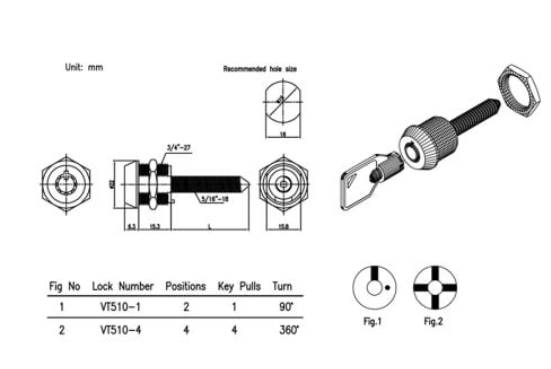
Cam locks are typically specified along two dimensions: cylinder diameter (the hole in the cabinet panel the lock fits through) and lock body length (how far the cylinder extends behind the panel).
Jin Tay manufactures cam locks in three standard diameters: 12 mm, 16 mm, and 19 mm. Custom diameters are available for OEM projects.
Jin Tay’s standard cam lock body lengths are 16 mm, 22 mm, 28 mm, and 34 mm — chosen to accommodate the most common panel thicknesses and cam clearances in cabinet hardware.
Application | Diameter | Notes |
Compact display cases, small enclosures | 12 mm | Smallest footprint; limited panel space |
Standard office furniture, mailbox or postbox | 16 mm | Most common general-purpose specification |
Industrial cabinets, outdoor enclosures | 19 mm | Largest standard; high security with a master key design |
• Diameter cam locks — Categorized by standard 12 / 16 / 19 mm diameters for general cabinet use
• Vending machine locks — Purpose-built for vending and coin-operated equipment
• Push-in locks — Press-to-engage cam locks for quick cabinet closure
• Security cam locks — Disc-tumbler designs with anti-drill cores for higher-security applications
• Glass door locks — Integrated handle-and-lock units for glass display cases
• Handle locks — Cam locks with enlarged knobs that double as cabinet handles
A security cam lock is a higher-grade cam lock designed to resist picking, drilling, and tampering. Jin Tay’s security cam locks use 7 to 14-disc and pin tumbler designs, supporting over 10,000 key combinations. The housing is built from high-grade zinc alloy and stainless steel, with anti-drill protection built into the cylinder face — a steel ball placed at the front so that drilling attempts fail to grip and destroy the core. Dust shutters, weatherproof sealing, and corrosion-resistant materials are standard. These cam locks are RoHS 2.0 compliant.
• Unique key codes — Each cam lock can be keyed to one of up to 50,000 distinct key codes, supporting large-scale differentiated access
• Master key systems — One master key can be configured to operate up to 500 cam locks, giving facilities managers a single override key while each individual lock remains uniquely keyed
For large facilities — office buildings, school systems, hospitality chains, or equipment rental fleets — master key systems dramatically reduce the operational overhead of managing per-cabinet access.
Specification | Standard Options |
Cylinder diameter | 12 mm · 16 mm · 19 mm (customizable) |
Lock body length | Customizable lengths available |
Key rotation | 90° or 180° (application-specified) |
Key code combinations | Up to 50,000 unique codes |
Master key support | Up to 500 locks per master key |
Security grade | Standard / Security (7~14-disc with anti-drill) |
Material | Zinc alloy (most), brass, specialty plastics, stainless steel material option |
Compliance | ISO 9001 quality system, RoHS 2.0 |
Q: What is the difference between a cam lock and a cabinet lock?
A: “Cabinet lock” is an umbrella term covering any lock used on a cabinet — including cam locks, combination locks, electronic locks, and key switch-style locks. A cam lock is one specific type of cabinet lock, defined by its rotating cam plate mechanism. So every cam lock can be called a cabinet lock, but not every cabinet lock is a cam lock. When B2B buyers specify “cam lock,” they mean this particular mechanical design — not the broader category.
Q: How many cam lock key codes can Jin Tay supply?
A: Jin Tay cam locks can be keyed to up to 50,000 unique key codes. For large deployments this means each cabinet in a facility can receive a differently-keyed lock, while still being managed through an optional master key system that operates up to 500 cam locks. For OEM buyers, Jin Tay can discuss specific keying schemes aligned with the deployment’s authorization plan.
Q: Are cam locks secure enough for high-value applications?
A: Standard cam locks provide adequate security for general office, retail, and residential cabinet use. For higher-value applications — bank ATMs, pharmacy cabinets, secure server racks — Jin Tay’s security cam locks offer 7 to 14-disc tumbler designs, over 10,000 key combinations, and built-in anti-drill protection. The appropriate security level depends on the value being protected and the threat model — procurement teams should align cam lock security grade with their risk assessment.
Q: Can cam locks be used on glass cabinet doors?
A: Yes — Jin Tay manufactures integrated glass-door cam locks where the handle and lock body are fabricated as a single unit. This eliminates the need to purchase and install a separate handle, and the rotating knob can also be enlarged to function as a small door pull. These are used in retail display cases, museum cabinets, and premium showroom furniture.
Q: Do cam locks require any power or battery?
A: No. Cam locks are fully mechanical and operate entirely through key-and-cylinder action. There are no batteries, no electronic components, and no network dependencies. For industrial environments where power may be intermittent, or where adding electronics to every cabinet is not practical, mechanical cam locks remain the default choice. Buyers who need electronic authorization logging or remote management should evaluate Jin Tay’s smart locker lock series as a separate category.
Q: Does Jin Tay offer OEM cam lock manufacturing?
A: Yes. Jin Tay has provided OEM cam locks to international manufacturers across office furniture, vending, industrial equipment, and retail display sectors since 1980. Standard customization includes diameter, lock body length, cam shape, key code specification, and master key configuration. For procurement teams evaluating cam lock manufacturers in Taiwan, Jin Tay can provide OEM documentation, sample units, and production capacity details on request.
Jin Tay was founded in Taiwan in 1980, with over 45 years of lock manufacturing expertise. Cam locks are part of Jin Tay’s original product lineage — one of the first product lines the company built, alongside key switch locks. The company operates under ISO 9001 quality management, with RoHS compliance across its European-facing product range.
For OEM buyers, Jin Tay offers flexibility in custom development — special cam shapes, application-specific diameters, and keying schemes can be engineered for projects with sufficient volume.
Looking for a reliable cam lock manufacturer with 45 years of OEM experience?
Request the Jin Tay Cam Lock Catalog — Full specifications, sizes, and configurations
Contact for Specifications — Speak with Jin Tay’s team about your application


