Hot Keywords:
- All
- Product Name
- Product Keyword
- Product Model
- Product Summary
- Product Description
- Multi Field Search
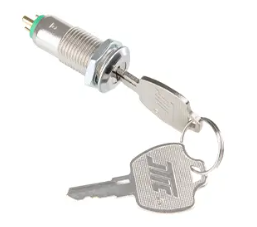
Most key switch locks have 2 or 3 switching positions, and configurations go up to 8. A "position" is a defined stop of key rotation, and each position connects or disconnects a circuit through the terminal pins at the rear of the lock. Choosing the right position count is the single most important
Cam locks are found in millions of industrial and commercial installations worldwide — from electrical enclosures and filing cabinets to mailboxes and vending equipment. Despite their small profile, they are precision-engineered mechanical devices. Understanding how a cam lock works helps procuremen
Cam locks are one of the most widely deployed locking mechanisms in industrial and commercial settings — from server racks and electrical panels to vending equipment and office furniture. But are they actually secure? The answer depends entirely on the design tier. Standard cam locks offer basic mec
Selecting the wrong cam lock size is one of the most common errors in equipment design and procurement. A lock that is too small may not fit the panel cutout or provide adequate engagement depth; a lock that is too large can interfere with adjacent hardware. Choosing correctly requires understanding
Bike theft happens fast — often in under 60 seconds. A standard padlock can physically restrain a bicycle, but it produces no alert when attacked. A smart alarm padlock combines the mechanical security of a conventional padlock with a vibration-triggered alarm and NFC-based electronic authentication
Jin Tay is a Taiwan lock manufacturer founded in 1980, with over 45 years of lock manufacturing expertise spanning cam locks, key switch locks, smart locker locks, and smart alarm padlocks. In June 2026, BusinessNext, one of Taiwan's leading business and technology media outlets, published a feature